Taste Is All That’s Left
NOTASHELF.DEV
I found this a highly thought-provoking article, and was a little disappointed that some commenters thought it was LLM-generated simply because of the writing style (em dashes and staccato sentences).
It starts with an observation which I think most of us will find to be entirely true, that the cost of developing software has dropped to near zero:
“The idea-to-artifact distance, the one that defined the entire craft, has collapsed to almost nothing.”
But while it is now almost trivially easy to create software, creating something of genuine value, or real quality, is still hard. In the past, the effort required to build something acted as a filter; we were selective in where we spent that effort, driven by a somewhat instinctive notion of quality.
“Effort was a filter, and like all filters it was invisible until it was removed.”
The rest of this article argues that taste, an instinct for quality, is now the most valuable skill - potentially the only skill - that is left.
Stateless MCP has recaptured my interest
SIMONWILLISON.NET
Model Context Protocol (MCP) was introduced by Anthropic back in November 2024 and rapidly became the de-facto standard for allowing LLMs (AI agents) to access external resources (e.g. web search, or local files and codebases). It was somewhat eclipsed by Skills and Claude Code, which favours giving an agent direct access to the command line in order to interact with files and resources. However, it is still widely used and supported.
The original version of MCP required two HTTP requests in order to interact with a service, one to create the session and a second with the intended request (e.g. web search). The newly released stateless MCP interface (v2) allows stateless sessions, supporting simple operations via a single HTTP request.
While this isn’t terribly exciting (at least in my opinion), Simon makes the very good point that giving an AI agent access to a command line is fraught with risks (it might escape your sandbox and hack Hugging Face for example!), whereas MCP provides an agent with a much smaller surface to interact with. While it isn’t entirely safe, and prompt injection is still an unsolved issue, it is much easier to secure than the command line alternative.
Eight Myths on Software Engineering and GenAI
ACM.ORG
I didn’t find anything terribly ground-breaking in this article, the myths it cites (devs spend most of their time writing code, everyone is now a 10x developer, writing code is the bottleneck, etc …) are all painfully familiar - and I’d hope that they are well known and widely challenged.
However, the reality is that for people who are not close to software engineering, haven’t written code or managed a software project, these myths still persist. If you’re working in an organisation whose approach to adoption is all wrong, this is a useful article to send to ‘management’. The underlying theme here (although not explicitly stated) is that AI adoption is an organisational challenge, not just a tooling one.
Qwen3.8 Ranked as the Best Overall Model by Agentic Index
YCOMBINATOR.COM
The latest model release from Alibaba, Qwen 3.8, topped the Artificial Analysis benchmark (a composite of other well-known benchmarks) - beating Claude 5 and GPT 5.6. Another victory for Chinese open weights models. Although notably, the model weights haven’t been released yet - they are expected sometime next week.
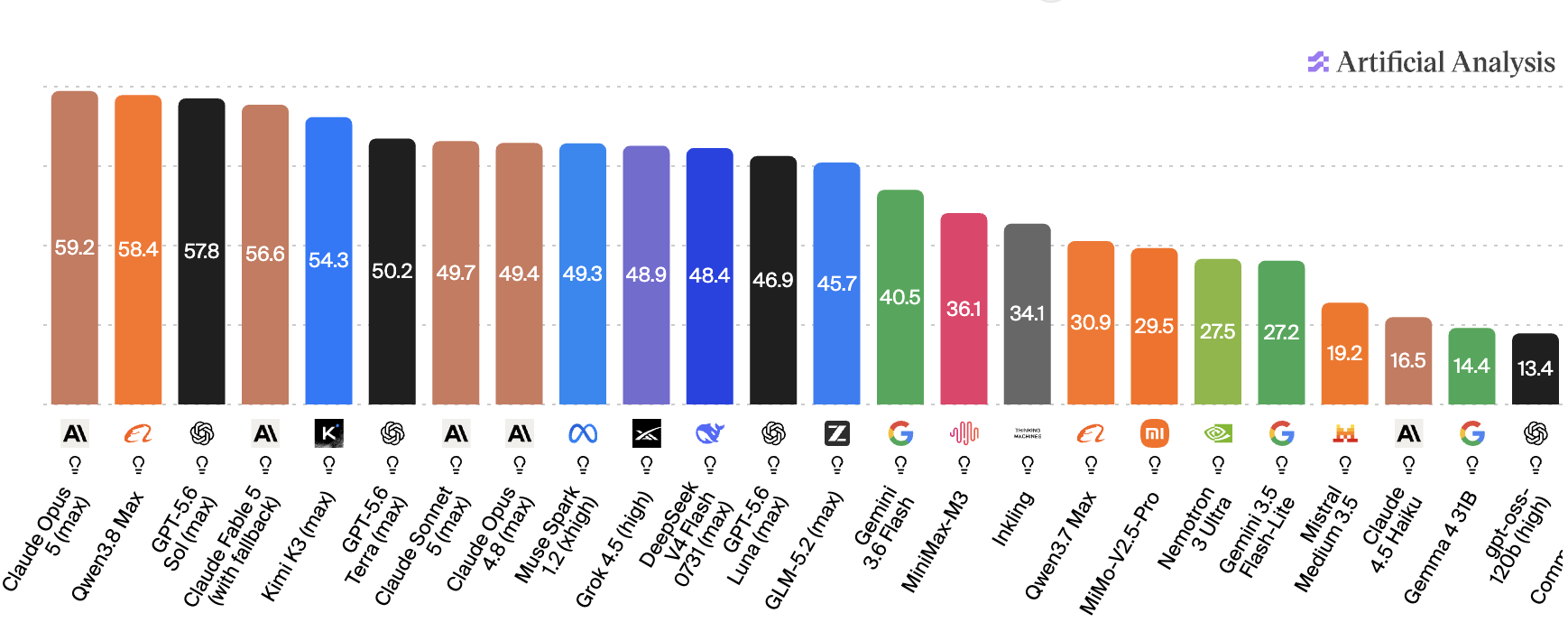
Also, shortly after Qwen reached no.1 the Artificial Analysis team updated the way they calculate the index, with the model dropping down to second place. As you can imagine, this caused a lot of suspicion!
Introducing Muse Code and Muse Spark 1.2
META.AI
A few weeks ago Meta, who have been quite far behind the frontier, released Muse Spark. Historically they have focussed on releasing open weights models (through the Llama series), however Spark is the first API-based model release from Meta, where they are clearly looking to commercialise their AI models.
Muse Spark 1.2 is a more coding-focussed update, but more interesting is the release of Muse Code, their own coding harness. It looks like Meta is now competing on the agent rather than the model.