Introducing MAI-Code-1-Flash
MICROSOFT.AI
A few years ago Microsoft had a near-perfect partnership with OpenAI, they cloud provider via Azure, and gained privileged access to OpenAI models for products like Copilot. This gave Microsoft a differentiated AI engine before most of its competitors, that should have given Azure, GitHub, Office, Bing and Copilot a big competitive advantage. However, the AI features across the MS products were weak, and as the compute needs of OpenAI outgrew Microsoft, their access to the technology was watered down to a right-of-first-refusal in 2025, and has now been erased. Microsoft should have started the AI race in a leading position, but blew it!
Microsoft has launched a few of its own models, including the Phi series a couple of years ago, smaller models designed for enterprises wishing to self-host. But these have failed to have an impact.
They have clearly acknowledged the need for their own model technology and have recently released seven new models, including MAI-Code-1-Flash, which is targeted at coding.
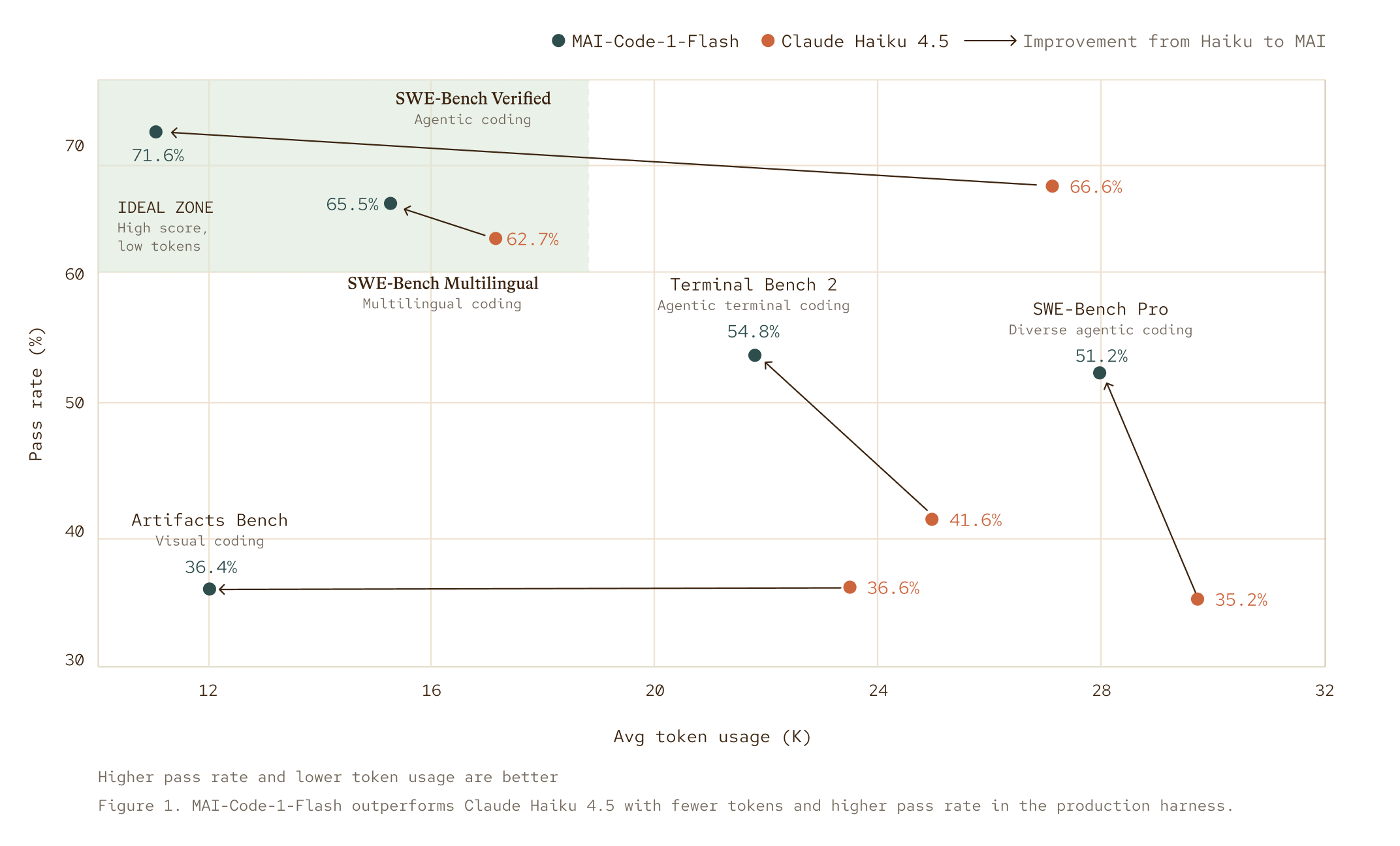
It isn’t pitched as a competitor to the frontier models (Claude Opus, GPT 5.5 Max), rather, it is targeted as a competitor to Anthropic’s lower cost Haiku model. Given the recent increase in token prices, this could be a smart move.
Is AI causing a repeat of Frontend’s Lost Decade?
GITHUB.IO
It is clear that we are undergoing a significant (and rapid) change in our industry. Something which we are all having to come to terms with in our own way, both positive and negative. One way to rationalise the change we are experiencing today is to draw parallels with other industry changes that have largely reached their conclusion. In this blog post, the author compares the introduction of AI to the significant changes we have experience in front-end development.
Front-end development used to be a specialist skill, steeped in the complexity of writing cross-browser CSS, HTML and JavaScript. I used to do quite a lot of web UI work back then, and honestly, it wasn’t easy. However, a couple of things have changed, firstly, browsers are now much more standards compliant, and secondly, we have frameworks such as ReactJS that abstract away some of the messier elements of the underlying platform. This ultimately makes front-end development easier and more accessible.
“The deskilling of the frontend was the introduction of frameworks and other tooling that treats the browser as a mere compilation target”
Is this deskilling? i.e. has it effectively eliminated a class of skill from the developer population? And are we experiencing the same with agentic AI, which is not writing a lot of our code.
The author isn’t entirely sure, and also explores the notion that we are now working at a higher level of abstraction, or, perhaps this is similar to the introduction of stackoverflow and copypasta?
The post meanders through a few more comparisons, including the Bauhaus movement. An interesting read, and I like the way that the author doesn’t have a definitive answer - which is rather unusual these days!
This is a vibe-coded motherf**ng website.
AGENTICMOTHERF***ING.WEBSITE
If you’re unfamiliar with the MFW concept, it all started with this one, a humorous, and expletive-filled push back against the latest trends in web development. It spawned many equally humorous imitators.
Given that context, have fun reading this website. The observations, while laced with sarcasm, are very astute.
They’re Made Out of Weights
MAXLEITER.COM
And another light-hearted, yet thought-provoking article. How can LLMs do such amazing things, recall a vast amount of facts, reason, converse and think, when they are simply a collection of weights? I think about this from time to time, but honestly, it makes my head hurt!