The Web Dev State of AI 2026
STATEOFAI.DEV
This is the second edition of the “Web Dev State of AI” survey, and teh results are packed with interesting insights. As the introduction states:
“AI-assisted coding’s transition from an early-adopter experiment to a standard practice is now well underway.”
Here are some of the interesting findings from the 7,258 developers surveyed:
- We are producing much more code with AI, respondents reported that ~54% of their code is now AI generated (up from 28% last year)
- We are using AI much more often, the percentage of respondents stating they use AI “constantly” has doubled.
- Claude Code is the most ‘loved’ tool, and up 26% in overall usage. GitHub Copilot comes in at a close second
- Despite being a new entrant, Claude Code is the ‘most payed for’ tool, indicating a rapid industry adoption
- People are paying more for their AI, with a 9% climb in people paying $100-$500 per month
- CodeRabbit is the leading AI review tool, although 83% don’t use AI review tools at all
- There is a strong interest in locally hosted AI, with 49% having tried local models
However, it isn’t all good:
- There is a significant increase in perceived threat to job security (19% increase in people who agree)
- Military use, Environmental impact and the general challenge of AI slop are the next three biggest concerns
- the biggest missing features are truthfulmess, long-term memory and Up-to-date knowledge
- There are concerns about the long-term industry impact, with 68% agreeing that reliance on AI will result in less skilled developers in the future (up 8%)
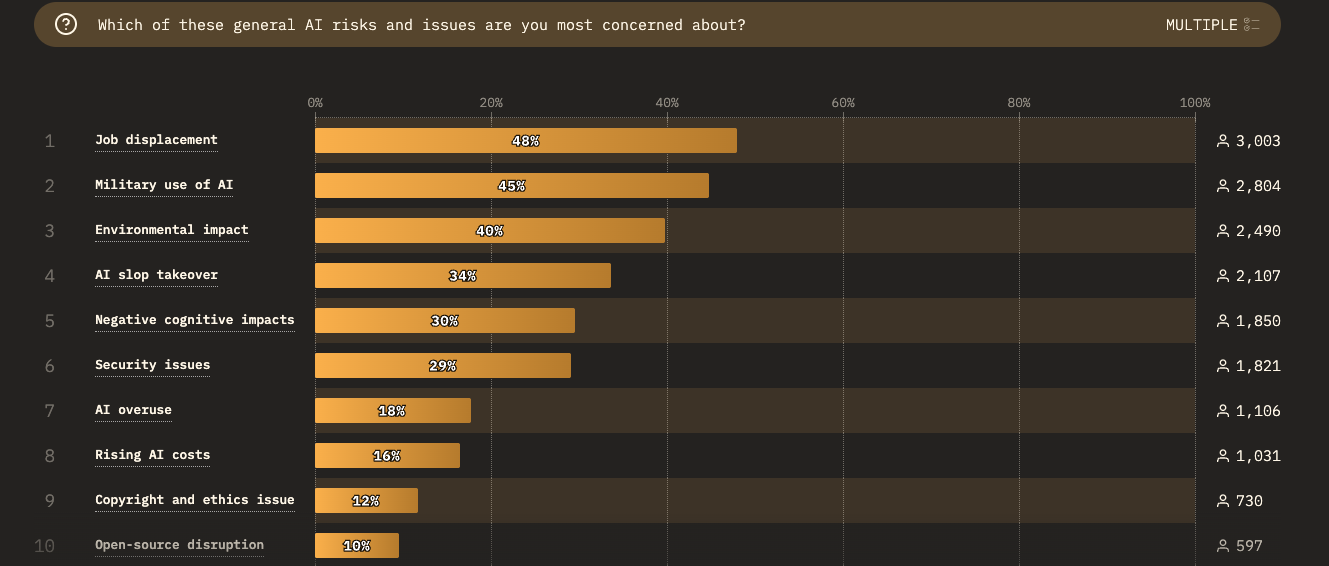
There is lots more data to dive into - a great report.
Let’s talk about AI slop - Is it the end of open source we know and love?
ARCHESTRA.AI
Archestra is an open source AI platform with 3.7k stars who are battling with AI slop.
A little while ago they posted an issue for adding MCP support to their platform, with a $900 bounty attached. Unfortunately it grabbed the attention of an army of bots, with the issue drowning in automated comments. These were AI-generated implementation plans that at times had aggressive messages towards maintainers. The problem got worse from there, a request to add an x.ai feature attracted 27 AI-authored pull requests.
As the author notes, while GitHub are celebrating a significant increase in AI-usage on their platform (>80% use GitHub Copilot), the reality for many maintainers is a degradation in contribution quality, coupled with a significant increase in volume.
Their solution to this problem has been to block anyone who isn’t a ‘prior contributor’ from any interaction with the repository, and add a forms-based on-boarding process for potential new contributors. This is similar to the approach Ghostty took with their ‘Vouch Request’ system. Unless GitHub does something to address the rise in AI-slop, we’re going to see more of these contribution gates being put up/
Codex-maxxing
JXNL.CO
OK, so the title of this post is a bit off-putting. The ‘maxxing’ term is used to describe the practice of encouraging employees to maximise their AI consumption, with little regard for the value or ROI of their consumption. This post is about something else, it is about using Codex, a tool targeted at developers, for more general knowledge work.
I’m also doing the same. I rarely use Claude Code for writing code, instead it has become my go-to general purpose agent. I know that Claude Cowork was deigned for that purpose, but at hides a lot of the important detail (e.g. logs) that allow me to optimise my prompts, skills and plugins.
This post has a lot of great ideas, a number of which I haven’t tried myself (e.g. durable threads). It also has some more ‘OpenClaw’ style moments, for example, using Codex o get a refund for a lost Amazon package. I must admit, some of the ideas such as using Codex to prioritise and draft responses to colleagues, go too far for my liking. But those few aside, lots of great ideas to try out here.
AI didn’t kill your junior pipeline. You did
ANDREWMURPHY.COM
Strong words from Andy Murphy! This post was bourne out of the frustration he experienced when seeing someone ridiculed for posting a job ad for junior engineers on a slack channel. What followed was replies along the line of “lol, companies still hire juniors?” and stupid memes.
Andrew shares that:
“Somewhere in the last eighteen months, the engineering industry collectively decided that an entire tier of the profession was obsolete. Not through research. Not through careful analysis of what the talent pipeline actually needs. Through vibes. Through memes.”
Unfortunately we are in an odd situation right now. The skills required to steer AI, and achieve the velocity multiples most organisations are aiming for, are those associated with more senior engineers - systems thinking, architecture, security and the most important … compromise. But concluding that we don’t need junior engineers any more is very short-sighted. Andy does a great job of ripping into this flawed conclusion.
We do still need junior engineers, of course we do. The question is, how do we train them? How do they acquire the skills that most of us took a number of years to craft while directly engaging in the act of writing code. We need to find ways for junior folk to acquire these skills more rapidly, and with fewer keystrokes. This isn’t going to be easy.