Yes, and…
HTMX.ORG
There are a lot of concerns about the future of (human) software engineers, and what the career path for those wishing to enter this industry might look like in the future. This blog post, from a university lecturer, directly answers the question “Given AI, should I still consider becoming a computer programmer?” I very much agree with all the points they make.
Firstly, they frame computer programming as problem-solving and managing complexity, not just writing code. A very important distinction. However, while AI will likely write most of your code for you, they are quick to caution that you still have to learn how to write code for yourself. We still need to have a full understanding of what AI generated code is doing, even if we don’t always choose to look.
The second part of the post focusses on the many skills that have always been important to be a successful software engineer (communication, business understanding, architecture), that are just as important (if not more so) in this AI age.
Lots of great advice.
AI Is a Tool. Using It Well Takes Skill.
YYHH.ORG
One of the final points made in the above article is that LLMs are a tool and that using them effectively is a skill. This blog post builds on that theme, outlining how complex this tool is and arguing that its unpredictability is a meaningful limitation. However, “a tool does not stop being a tool because it is difficult to control or easy to misuse.”
I very much agree with this sentiment. Learning how to control this powerful, yet unpredictable tool takes time, especially as the technology is rapidly evolving under our feet. This is going to become one of the most important skills in our industry.
Your AI agents, in a stand-up call.
GITHUB.IO
This is just a bit of lighthearted fun (I think). This project turns your agent coding session into a live team meeting. Cute characters pop up and describe the work they are currently doing, discuss blockers, etc.
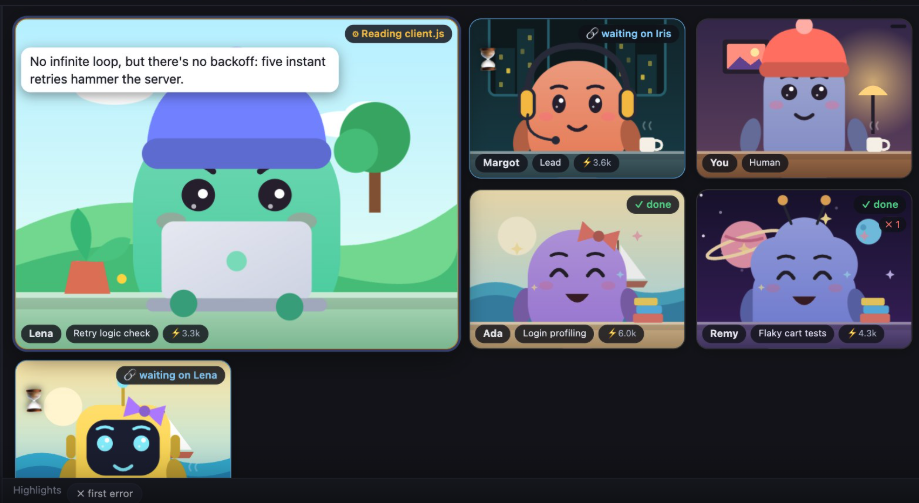
It is described as “It’s a bit silly. It’s also weirdly useful.” - I agree with the silly part!
Open Source as We Know It Is Dead
JROSS.ME
There are far too many blog posts that state “the death of x”, but in my opinion, this one is quite fitting.
James is a self-taught engineer, owing much of this to the open source community. Yes, he learnt a lot from the code, but gained so much more from the community itself. Here he describes his early experience of a PR being merged:
A maintainer merged both the next morning - no back and forth, no checklist, no bots. A stranger sent them 300 lines of unsolicited changes, and they took a chance on it. I can’t fully explain what that did for me, except that it made me feel like I belonged.
Whereas now human-authored PRs tend to be met with a wall of comments from AI bots (code review, triage, repro steps and more), which you have to wade through ahead of any human contact. They serve a useful purpose, but make it harder for real humans to connect. And of course many PRs and issues are now written by AI bots either on behalf of humans, or fully autonomously. I do quite a lot of work in open source and I’ve seen this increase by orders of magnitude in the last few months.
Many open source projects are now pulling up the drawbridge (curl, tldraw, OpenJDK, Godot, …), intentionally putting obstacles in the way of contribution, and many have simply disabled PRs altogether. A project that doesn’t accept contributions isn’t really open source at all.
GitHub doesn’t help. There is no distinction between bots and humans on their platform, leaving us to infer via em dashes and other behavioural tells.
Sadly James doesn’t know what the fix is, and neither do I.
The Velocity Trap
GITHUB.IO
And finally, a couple of weeks ago I wrote a novella!
OK, to be more precise, I worked with Claude to write a novella. I wanted to create a “Phoenix Project” for the AI age. A business fable that brings to life the challenges we are currently facing as an industry. I enjoyed creating it, and perhaps one or two people will read it!