GPT 5.6 Released
OPENAI.COM
We first heard about GPT 5.6 three weeks ago when OpenAI declared a preview release would be available to a small number of partners, based on discussions with the US government. A direct fallout of the Anthropic Fable shutdown, where the government determined that the risks associated with the Fable model warranted immediate action.
GPT 5.6 is now available as a general release and as expected the relentless improvements across a range of benchmarks continues, beating previous models (and Anthropic’s Fable 5) on a wide range of metrics. It is available in three flavours (Sol, Terra, Luna) giving a range of price and capability, each of which can be used at five different reasoning levels. Furthermore, with Sol you can select an ‘ultra’ model which coordinates multiple agents across parallel workstreams to finish complex tasks faster.
I must admit, for the past few months I’ve paid little attention to the metrics and benchmark scores within frontier lab model releases. They have been more than capable for the tasks I want to achieve for months now. I believe we are at a point now where there are more gains to be made by considering how you use an agent, rather than which model you choose.
But what is interesting is the positioning of this release, cost and efficiency are front and centre. Charts showcasing benchmark scores used to be column charts, i.e. the %age score is all that matters. Whereas in this post they are all have an additional axis that plots benchmark score against cost, latency or tokens.
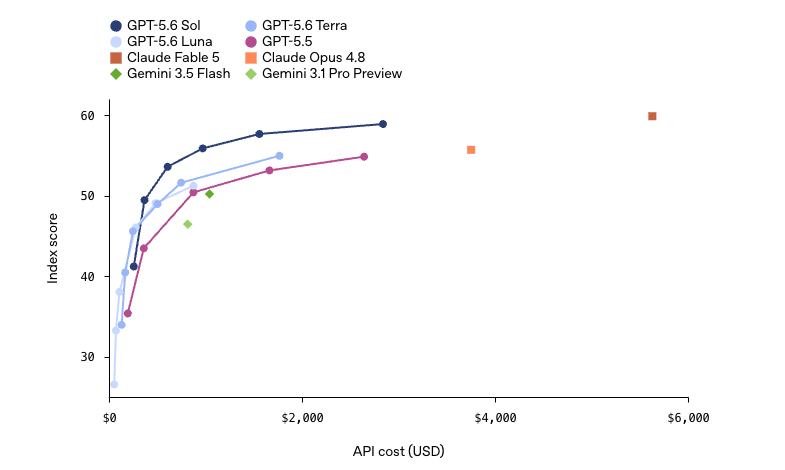
The message is very clear - cost has all of a sudden become a significant concern. The strapline for this model start:
“More intelligence from every token, stronger performance per dollar, …”
Colibri - run GLM 5.2 on consumer hardware
GITHUB.COM
And on the subject of cost once again, when GLM 5.2 was released a month ago it caused quite a stir, with benchmark scores that were only 2 months behind the frontier (previous wisdom was that open weights was around 6 months behind). However, despite being open weights, running it locally involved heavy quantization and some beefy hardware.
Quantization involves taking the original model weights and reducing their bit-depth (i.e. reducing their overall precision). This works surprisingly well, even when applied aggressively - for example 2-bit quantization of GLM 5.2 reaches ~82% accuracy while being 84% smaller.
Colibri introduces a more novel approach.
GLM 5.2 is a Mixture of Experts model, it is effectively many smaller specialist neural networks connected together by a learned router, with a shared backbone that all tokens pass through. As a result, for each token only a small number of parameters are activated. The project author observed that of the 744 billion parameters, typically only 40 billion are activated for a given token.
Colibri capitalises on this by keeping the core of the model (attention, router, tokeniser) in memory, while keeping the ‘experts’ on disk, streaming them on demand via a caching layer.
The end result runs on entirely commodity hardware.
Now this isn’t a practical solution yet, running at one or two tokens per second, but it does show that there is massive scope for further creativity around open weights models and architectures design and optimised for local execution.
Why write code in 2026
SOFTWAREDOUG.COM
As software engineers we are now spending much of our time harness engineering, creating the environment needed for safe and autonomous agent execution. We are building the software factories as this blog post puts it. So does that means we shouldn’t write code anymore - ever?
This blog posts takes the position that …
“It’s still useful to write code.”
And a completely agree.
This brief post provides numerous reasons why it is still valuable to write code, it supports our attention and understanding and most importantly it helps us think. Something which we should not be outsourcing to AI models.
I still write code, deliberately undertaking sessions without the assistance of AI. I’m making my way through the Advent of Code back catalogue because I enjoy writing code and still think it is a valuable skill.
Introducing Muse Spark 1.1
META.AI
And another model release, this time from Meta. It isn’t quite frontier-strength on benchmarks, but is pretty close.
What this does represent is a strategic shift for Meta, who were late to the LLM game. Historically they have focussed on releasing open weights models (through the Llama series), however Spark is the first API-based model release from Meta, where they are clearly looking to commercialise their AI models.
Notably, they are looking to compete on price, with Mark Zuckerberg stating the following:
“The pricing from some of the other labs is very extreme and has very high margins. We think that there’s a real ability to be able to offer frontier or very high-level intelligence at a much more affordable cost.”
Kimi K3: Open Frontier Intelligence
KIMI.COM
And another …
Kimi is the family of open weights large language models developed by Moonshot AI, a Beijing-based startup. And once again, the benchmark scores are all presented as performance vs cost. Interestingly this blog post details the high-level architecture of this model, something which is completely opaque with the frontier labs.
Just for fun, this is what Kimi came up with after a 3 hour session working on the prompt “recreate macOS 27 with real Liquid Glass and native apps in web browser”
https://macos27.kimi.page/