AI Is Forcing Us To Write Good Code
LOGIC.INC
While 2025 was the year of coding agents, I think 2026 is going to be the year of discovering how to get the most out of them. This blog post is a very good starting point.
The key argument here is that the ‘good code’ is a well understood concept. Thorough tests, clear documentation, small well-scoped modules, static typing, dev environments you can be rapidly spun up. These things were often seen as optional. However, coding agents also need these things to be truly effective, and with the productivity boost agents can provide, the value in these ‘optional’ grows significantly.
The rest of the post outlines how code coverage, namespacing, ephemeral environments and static typing (with clear naming), can help make a coding agent more productive.
“Agents are tireless and often brilliant coders, but they’re only as effective as the environment you place them in. Once you realize this, “good code” stops feeling superfluous and starts feeling essential.”
Vibe coding a bookshelf with Claude Code
BALAJMARIUS.COM
Prior to coding agents, when writing an app you’d typical invest weeks, months or years in solving a problem that you assumed was shared by a large number of users. You’d rarely invest that much time and energy into solving a problem just for yourself. However, with coding agents and the speed at which they can write applications, that calculus has all changed.
This blog post is a great example of just that.
The author has a book collection that they want to manage and catalogue, the sort of thing you’d typically do with a spreadsheet, or simply not both with. There are some book cataloguing applications, but they did a poor job for this author’s collection due to the more obscure nature of the texts.
Creating a bespoke app involved photographic covers, using Claude Code to write an image processing utility to read the covers, writing a script to fetch cover images - then the fun part, creating a visual bookshelf complete with animations. I really like the way the colour for the spine of each book is based on the cover using quantisation.
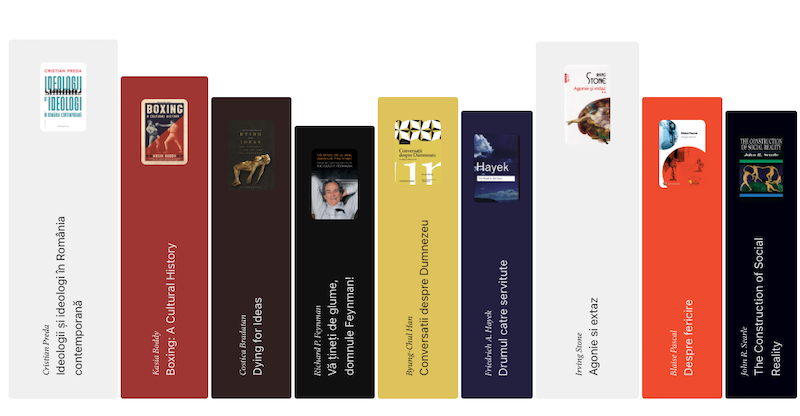
You can see the finished application here.
An experiment in vibe coding
NOLANLAWSON.COM
And a very similar post from Nolan, who vibe coded a Progressive Web App (PWA) for his wife to manage travel itineraries.
Interestingly he started with Bolt, a tool specifically targeted at vibe coding, but he found that the quality of the app degraded significantly as the complexity grew, so he switched to Claude Code.
While the results were positive, Nolan is somewhat skeptical of how much you can achieve by vibe coding if you lack direct experience in building web applications, hitting issues with performance and accessibility, i.e. the non functional requirements.
Nolan shares some interesting reflections at the end of this post. Here are a few direct quotes:
“I’m somewhat horrified by how easily this tool can reproduce what took me 20-odd years to learn”
“I’ve decided that my role is not to try to resist the overwhelming onslaught of this technology, but instead to just witness and document how it’s shaking up my worldview and my corner of the industry”
“I have no idea what coding will look like next year (2026), but I know how my wife will be planning our next vacation.”
2025: The year in LLMs
SIMONWILLISON.NET
Simon provides a fantastic roundup of the significant news relating to LLMs in 2025. Unsurprisingly around half of these relate to AI coding. Here are a few brief highlights:
- 2025 as the year of coding agents: Simon identifies coding agents as the most significant LLM development for software engineers, with models that can write, run, inspect, and iteratively refine code.
- Claude Code as the standout tool: Anthropic’s Claude Code is highlighted as the single most impactful coding-related release of the year.
- Explosion of CLI and agent-based dev tools: Tools such as Claude Code, Codex CLI, Gemini CLI, Qwen Code, and IDE-integrated agents became mainstream, showing strong adoption of LLMs in terminal-driven workflows.
- Asynchronous coding agents: Web-based and background agents allowed developers to submit tasks and return later for results, changing how longer coding tasks are handled.
- Reasoning models improved coding quality: Advances like RLVR significantly improved multi-step reasoning, debugging, and understanding of complex codebases.
- Shift in developer risk tolerance: The normalization of “YOLO” or high-autonomy agent behavior reflects a trade-off between speed and control in modern AI-assisted development.
- LLMs embedded in the SDLC: Overall, LLMs has become a first-class tools across the software development lifecycle, introducing both productivity gains and new verification challenges.
All of this in a single year. It is worth reminding ourselves that ChatGPT was introduced to us in November 2022.
I don’t see any signs that things will slow down into 2026.